Trends Shaping Next-Generation Data Centre Cabling Solutions
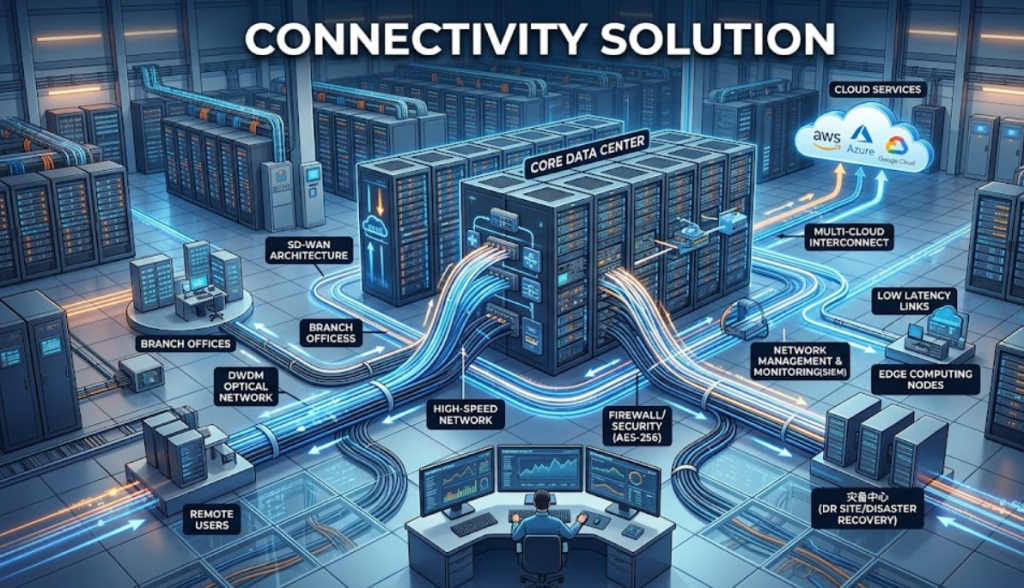
There was a time when cabling inside a data centre was considered a background decision, important, but rarely strategic. That has changed.
Today, cabling is no longer just about connecting equipment. It determines how efficiently data moves, how quickly systems scale, and how reliably infrastructure performs under pressure. As workloads become heavier and more distributed, the expectations from a modern data centre cabling solution are evolving at pace.
Several clear trends are shaping this shift.
The Rise of High-Density Fibre Infrastructure
The most visible transition is the growing dominance of fibre. As data volumes surge, driven by cloud computing, artificial intelligence, and real-time applications, traditional cabling approaches are being pushed to their limits.
Modern environments require:
- Higher bandwidth
- Lower latency
- Greater scalability
This has made high-density fibre architectures central to next-generation design. AI-driven workloads, in particular, demand rapid data exchange between servers and storage systems, making fibre-based cabling critical for performance.
At the same time, fibre counts within cables are increasing significantly. Hyperscale environments are now deploying cables with thousands of fibres to support growing interconnect requirements, while innovations in cable design are helping reduce physical footprint without compromising performance.
Data Centre Interconnect Is Becoming Core Infrastructure
Data centres are no longer isolated facilities. They operate as part of interconnected ecosystems, spread across regions, campuses, and cloud environments.
This is where data centre interconnect (DCI) is becoming indispensable.
DCI enables high-speed communication between facilities, allowing organisations to:
- Distribute workloads
- Ensure redundancy and disaster recovery
- Support real-time data synchronisation
The demand for these interconnections is rising rapidly, with the global market expanding significantly as AI and cloud adoption accelerate.
More importantly, the nature of interconnect is changing. Instead of simple point-to-point links, modern architectures rely on multi-layered connectivity, linking systems within racks, across halls, and between geographically distant data centres.
The Shift to Ultra-High-Speed Connectivity
Speed requirements are moving well beyond traditional thresholds.
Enterprises and cloud providers are now transitioning towards 400G and 800G connectivity, with even higher capacities on the horizon. These upgrades are not incremental; they represent a fundamental leap in how data is transmitted within and between data centres.
Newer optical technologies, such as pluggable coherent optics, are enabling:
- Greater bandwidth per port
- Reduced power consumption per bit
- Higher port density
This transition is being driven by the need to support AI training clusters, large-scale analytics, and high-frequency data exchange.
For any modern data centre connectivity solution, the ability to handle these speeds is becoming a baseline requirement rather than a differentiator.
Increasing Focus on Energy Efficiency
Cabling decisions are now closely linked to energy consumption.
As data centres scale, power efficiency has become a critical concern, not only for cost reasons but also for sustainability targets. Modern cabling technologies are evolving to reduce energy usage per bit of data transmitted.
Optical innovations such as silicon photonics and co-packaged optics are playing a key role here, enabling higher performance while lowering power requirements.
At the infrastructure level, this translates into:
- Lower cooling demands
- Improved thermal management
- Higher rack density without compromising efficiency
Energy-aware design is no longer optional; it is becoming a core consideration in every data centre cabling solution.
A Subtle but Critical Shift
The changes shaping modern data centres are not always visible, but they are deeply structural.
From high-density fibre deployments to advanced data centre interconnect strategies, the focus is shifting towards building infrastructure that can handle continuous growth without constant redesign.
Organisations that recognise this early are rethinking their approach to connectivity, moving beyond short-term fixes towards long-term resilience. Providers such as STL are contributing to this transition by enabling high-performance, scalable cabling solutions designed for next-generation demands.
Cabling may sit behind the scenes, but it defines how a data centre performs.
As workloads grow heavier and architectures become more distributed, the expectations from a data centre connectivity solution will only increase. The trends shaping this space are not temporary; they are laying the foundation for how digital infrastructure will operate in the years ahead.
And in that foundation, cabling is no longer secondary. It is central.













Post Comment