What the MSSP 2026 Changes Mean for Small ACOs: The 5,000 Beneficiary Rule, Explained
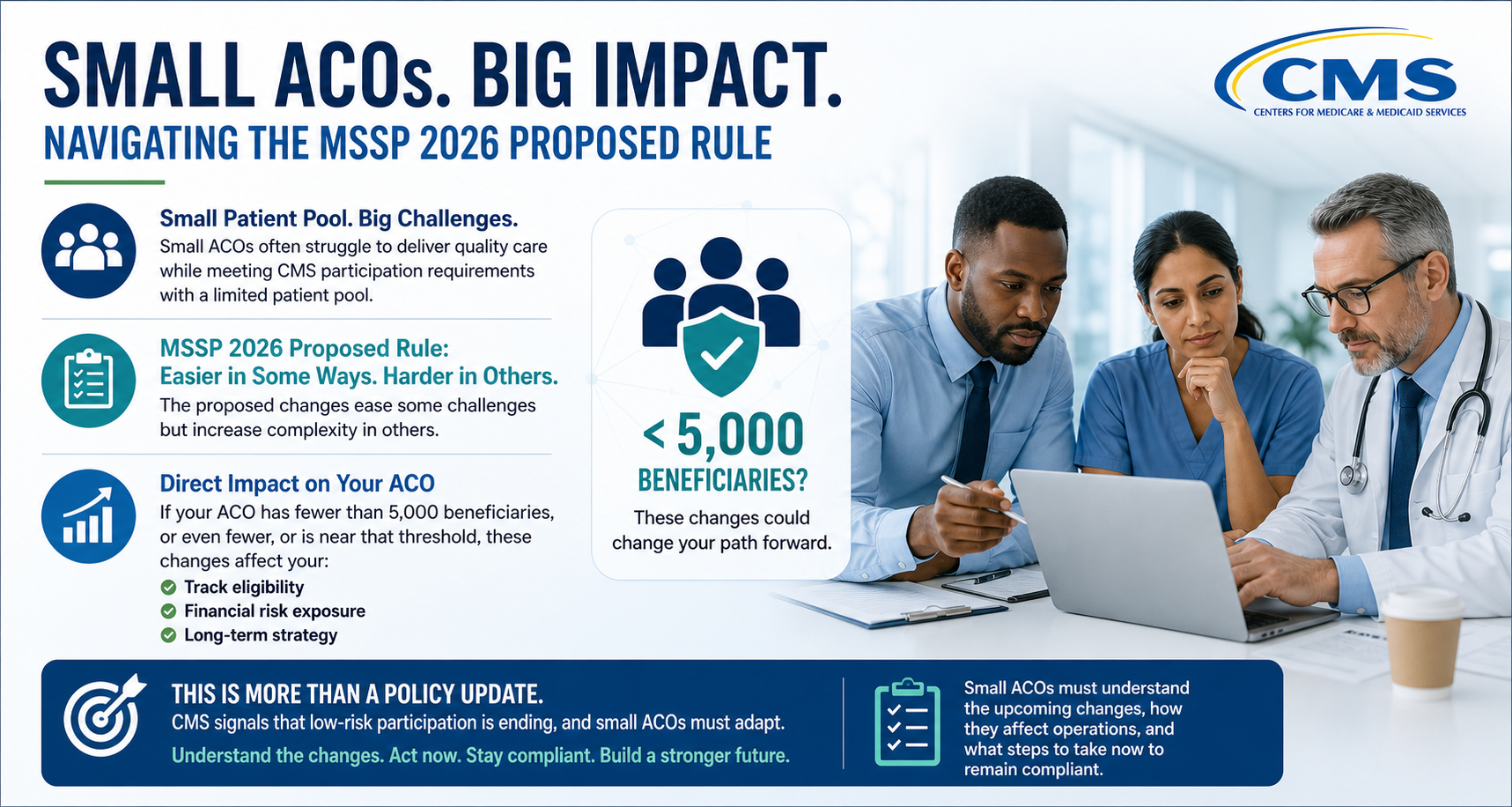
Small ACOs often struggle to deliver quality care while meeting CMS participation requirements with a limited patient pool. The MSSP 2026 Proposed Rule eases some challenges but increases complexity in others. When your ACO has fewer than 5,000 beneficiaries, or even fewer, or is near that threshold, the mentioned changes have a direct impact on your track eligibility, your financial risk exposure, and your long-term strategy.
This is more than a policy update. CMS signals that low-risk participation is ending, and small ACOs must adapt. Small ACOs must understand the upcoming changes, how they affect operations, and what steps to take now to remain compliant.
The 5,000 Beneficiary Rule, Redefined
The 2026 rule changes the timing for meeting the 5,000 beneficiary minimum. ACOs now must meet it by the third benchmark year instead of every year. Previously, this threshold applied to every benchmark year. Now, ACOs only need to hit it in the third benchmark year, giving smaller and rural ACOs more time to grow their patient panels before full compliance kicks in.
Why CMS Made This Change
CMS saw that the tight annual minimums were causing some smaller entities, in particular those in rural or underserved regions, to be out of the program altogether. The purpose of relaxing the time at which this threshold is set has a few objectives:
- Encourages community-based ACOs to enter or stay in MSSP
- Supports coverage in markets with naturally lower patient volumes
- Allows gradual, sustainable growth instead of forced rapid expansion
What Happens When You Fall Below 5,000
This is the limit of the flexibility. Should any ACO have fewer than 5,000 beneficiaries in any benchmark year, the CMS imposes strict limits:
- BASIC track only, no access to the ENHANCED track
- Caps on shared savings and losses, the financial upside is limited
- ACOs below 5,000 beneficiaries lose low-revenue bonuses and other flexibilities.
Being restricted to the BASIC track limits financial returns and excludes access to advanced two-sided risk programs. ACOs near this threshold need to manage their beneficiary counts actively, not just monitor them passively.
BASIC vs. ENHANCED: What the Tracks Actually Mean
The track an ACO qualifies for determines its entire risk and reward structure. Here’s a clear comparison:
| Track | Who Qualifies | Risk Type | Savings Potential |
| BASIC | All ACOs, including those below 5,000 | One-sided (early levels) | Capped |
| ENHANCED | ACOs meeting full requirements | Two-sided (mandatory) | Higher |
Small ACOs stuck in BASIC aren’t just missing higher savings. They’re also excluded from the programs CMS is investing in most heavily as value-based care matures.
Quality Measure Updates That Affect Small ACOs
The 2026 rule doesn’t only change participation thresholds, it also tightens how performance gets measured. These updates matter for small ACOs that are already stretched thin on reporting resources.
What’s Being Removed
- The health equity adjustment is dropped from ACO quality scores starting Performance Year 2025, CMS says it overlaps with existing incentives.
- Quality ID 487 (social determinants screening) is removed from the APP Plus measure set.
What’s Being Tightened
- Medicare Clinical Quality Measures eligibility now requires beneficiaries to receive at least one primary care service annually from a designated provider.
- Behavioral health integration and psychiatric collaborative care management now count as primary care services.
- CMS will monitor both standard and alternative quality measures starting in 2026, increasing oversight across frameworks.
For small ACOs, this means a narrower but more clinically focused reporting set with less room for gaps.
What Small ACOs Need to Do Now
The five-year countdown to mandatory two-sided risk is no longer hypothetical. Small ACOs that wait will find themselves underprepared when participation requirements tighten further. The priority areas are clear:
- Data integration: Clinical and claims data must work together to flag high-risk patients early
- Real-time monitoring: Quality gaps caught late cost more to fix than those caught early
- Population analytics: Proactive care decisions require population-level visibility, not just individual patient records
Conclusion
The MSSP 2026 Proposed Rule offers small ACOs time to prepare. Acting now ensures readiness for mandatory two-sided risk and tighter reporting standards. The beneficiary threshold adjustment buys time; it doesn’t eliminate the pressure. ACOs that invest now in data infrastructure, quality reporting, and risk readiness will be far better positioned as two-sided risk becomes standard across the program.
How Persivia Helps Small ACOs Stay Ahead
Persivia offers ACOs a purpose-built advantage in this environment. Through CareSpace®, an AI-powered digital health platform that unifies EHR data, claims, and social determinants into longitudinal patient records, small ACOs gain the population health visibility needed to proactively manage risk, close quality gaps efficiently, and meet CMS’s tightening standards without the operational overwhelm.











Post Comment