2026 Medicare Fee Schedule: What Changed for MSSP, MIPS, and Telehealth
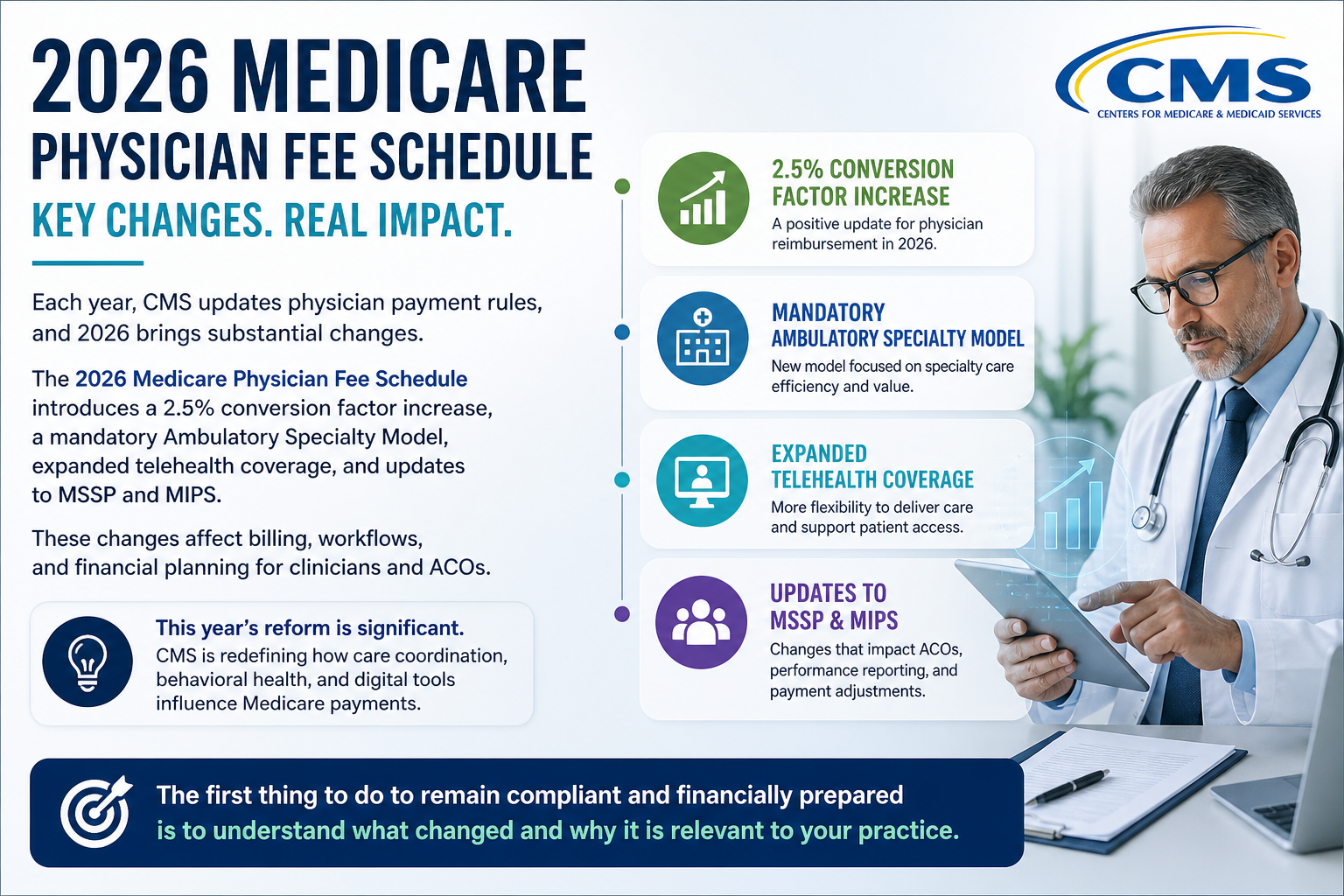
Each year, CMS updates physician payment rules, and 2026 brings substantial changes. The 2026 Medicare Physician Fee Schedule introduces a 2.5% conversion factor increase, a mandatory Ambulatory Specialty Model, expanded telehealth coverage, and updates to MSSP and MIPS. These changes affect billing, workflows, and financial planning for clinicians and ACOs.
This year’s reform is significant. CMS is redefining how care coordination, behavioral health, and digital tools influence Medicare payments. The first thing to do to remain compliant and financially prepared is to understand what changed and why it is relevant to your practice.
Payment Rates: How Much Is Actually Changing?
The proposed 2.5% increase in the 2026 conversion factor provides relief after years of stagnant or declining physician payments. Here’s a quick breakdown of who gets what:
| Provider Type | Payment Increase |
| Advanced APM Participants | 3.83% |
| Non-Qualifying Providers | 3.62% |
| Procedure-Based Specialties | May see slight decreases |
The efficiency adjustment applied to procedure-heavy specialties means the net impact varies. Providers should run specialty-specific projections rather than assume a flat raise across the board.
What’s the New Ambulatory Specialty Model (ASM)?
The ASM is the biggest structural change in the 2026 Medicare Physician Fee Schedule, and it’s mandatory.
Who It Targets
Beginning January 1, 2027, the Ambulatory Specialty Model will hold individual clinicians responsible for quality and cost in their treatment of two chronic conditions:
- Low back pain (LBP) anesthesiologists, pain management specialists, orthopedists, neurosurgeons, PM&R specialists
- Congestive heart failure (CHF) cardiologists
It has to be participated in if a specialist treated 20 or more Medicare fee-for-service patients with these conditions in specified geographic regions during 12 months.
What Two-Sided Risk Actually Means
ASM implements two-sided financial risk. Specialists may earn bonuses for high quality and cost performance, but may face penalties for underperformance. Medicare Part B payments are tied to quality metrics and care coordination outcomes.
ASM participants are exempt from MIPS reporting during participation years, with payment adjustments starting in 2029, allowing time to adapt.
MSSP in 2026: What’s Shifting for ACOs?
The Medicare Shared Savings Program sees targeted but meaningful policy updates this year.
Smaller ACOs Get a Path In
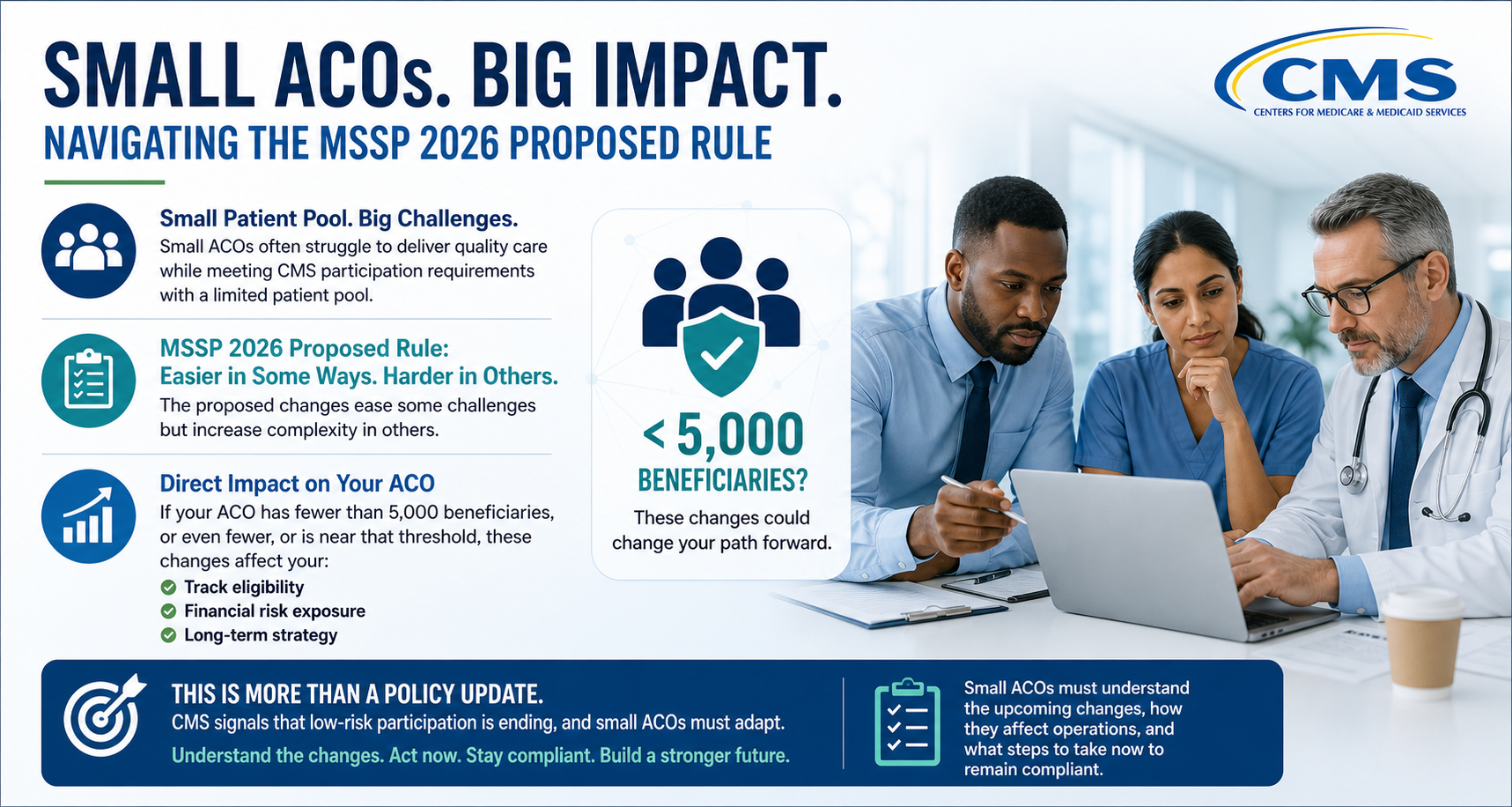
ACOs that have less than 5,000 beneficiaries can take part in Benchmark Years 1 and 2 beginning January 1, 2027. They should, however, reach the 5,000-beneficiary threshold by Benchmark Year 3. These smaller ACOs face:
- Reduced shared savings opportunities
- Capped financial exposure
- A structured growth timeline before full participation
Health Equity Adjustment Is Gone
Starting performance year 2025, the health equity adjustment for ACO quality scores is removed. CMS describes this as regulatory streamlining; benchmark methodology remains, but the equity bonus is discontinued.
MIPS Updates: What’s Different in 2026?
MIPS isn’t being scrapped, but it’s being refined. Providers in traditional MIPS tracks still face performance-based payment adjustments, while those entering ASM get a reprieve from reporting requirements.
Key updates to know:
- Quality Payment Program (QPP) requirements are refined alongside the ASM rollout
- Non-ASM specialists remain in standard MIPS tracks
- Practices without automated tracking may still face significant documentation burdens.
Behavioral Health: New Billing Codes, Less Red Tape
CMS adds new behavioral health add-on billing codes to expand reimbursement for integrated services, and the change is practical.
What’s New With APCM
Three new GPCM add-on codes now allow providers to bill:
- Collaborative Care Model (CoCM) services
- Behavioral health integration codes
- All of the above, alongside Advanced Primary Care Management (APCM)
The key shift: time-based restrictions are removed. The providers do not have to monitor and record hours to be eligible to use these billing codes, which will decrease the workload on the administration and motivate greater behavioral health integration in primary care practices.
Telehealth and Digital Health: Medicare Gets More Modern
CMS is expanding coverage for tools that didn’t exist in Medicare’s original framework, and 2026 marks a notable step forward.
What’s Expanding
- Digital mental health devices now have broader coverage, including tools for ADHD.
- The process for adding services to the Medicare Telehealth Services List is being simplified.
- CMS is soliciting feedback on payment models for AI tools and SaaS platforms in outpatient care.
This last point matters. CMS is not just acknowledging AI; it’s beginning to build a payment framework around it. Providers using a digital health platform for care management and analytics are positioned to benefit as these frameworks solidify.
Skin Substitute Payment: A Major Billing Overhaul
This one often gets overlooked, but it has a real financial impact on wound care and surgical specialists.
Previously, CMS paid based on individual Average Sales Prices, sometimes exceeding $1,000 per square centimeter. Under the new rule:
- CMS pays a uniform rate of $125.38 per cm²
- This applies across three FDA-based categories
- Billing shifts to incident-to supplies, not individual product pricing
For high-volume users of skin substitutes, this change significantly affects revenue projections.
Bottom Line
Beyond payment updates, the 2026 Medicare Physician Fee Schedule redefines accountability metrics, expands digital health coverage, and refines quality-of-care standards. As changes such as the compulsory ASM implementation, streamlined behavioral health billing, and expanded telehealth access become more prevalent, more providers can keep up with changes, guarantee proper reporting, and maximize reimbursements.
Persivia CareSpace® supports these changes with AI-powered quality monitoring, patient analytics, risk adjustment, and care coordination, helping practices and ACOs efficiently manage compliance and leverage regulatory updates strategically.












Post Comment