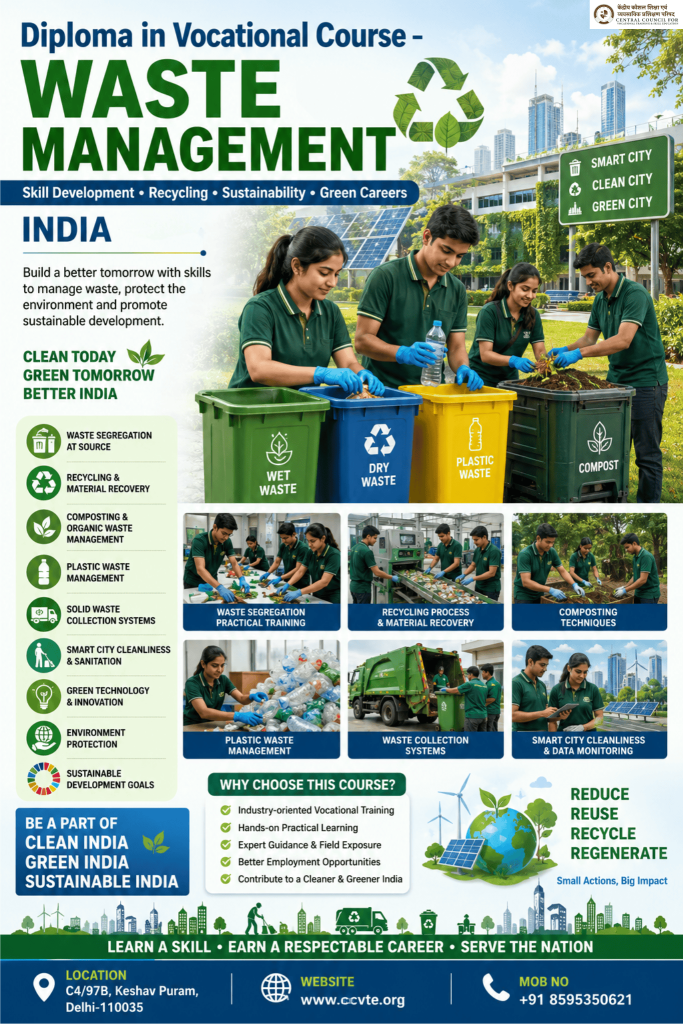

India is at a turning point in how it handles waste. With cities expanding rapidly and environmental regulations tightening, the demand for skilled waste management professionals has never been higher. If you are considering enrolling in a vocational course in waste management India, you are making a forward-thinking career move that aligns with one of the fastest-growing sectors in the country. From municipal solid waste to e-waste recycling, trained professionals are urgently needed — and vocational training is the most practical, affordable way to enter this field.
Why Waste Management Is a Career of the Future in India
India generates over 62 million tonnes of solid waste annually, and that number is growing. The government’s Swachh Bharat Mission, Smart Cities initiative, and new solid waste management rules have collectively created a massive infrastructure push — and with it, a rising demand for a skilled workforce.
Yet the sector suffers from a significant skills gap. Most workers in waste management today are untrained, which means organizations — both government bodies and private companies — are actively seeking certified professionals who understand waste segregation, recycling processes, hazardous material handling, and sustainability practices.
Vocational training bridges this gap. Unlike lengthy degree programs, waste management courses are designed to equip students with practical, job-ready skills in a matter of months.
What Do Waste Management Vocational Programs Cover?
Whether you enroll in a certificate in waste management or opt for a longer diploma track, the curriculum typically spans the following core areas:
- Solid and liquid waste classification — understanding municipal, industrial, biomedical, and hazardous waste
- Waste collection and transportation — logistics, safety protocols, and compliance
- Recycling and resource recovery — hands-on training in sorting, processing, and upcycling materials
- Environmental legislation — knowledge of India’s waste management rules and environmental protection acts
- Occupational health and safety — PPE usage, risk assessment, and emergency response
- Landfill and composting techniques — ground-level practical knowledge for field roles
Programs are available in multiple durations to suit different learners:
| Duration | Best For |
| 3 Months | Quick entry-level certification |
| 6 Months | Foundational role readiness |
| 1 Year | Mid-level job profiles |
| 2 Years | Supervisory and technical roles |
Eligibility: High School (10th or 12th pass) is sufficient to enroll. No prior technical background is required.
Read More – What Skills Do You Gain From a Pre Primary Teacher Training Course?
Career Opportunities After Completing Waste Management Courses in India
Completing waste management courses in India opens doors to a diverse range of career paths across both public and private sectors. Here is what you can expect:
Government & Municipal Bodies
- Solid Waste Management Officer
- Sanitation Supervisor under Urban Local Bodies (ULBs)
- Environment Inspector
Private Sector & Industry
- Waste Auditor at manufacturing plants
- Recycling Plant Technician
- Environmental Compliance Officer
- E-Waste Collection and Processing Specialist
NGOs & Social Enterprises
- Waste Educator and Community Outreach Worker
- Project Coordinator for zero-waste initiatives
Entrepreneurship
- Starting a small-scale recycling unit
- Composting and organic waste management service
- Waste consultancy for residential complexes or IT parks
The growth of recycling and waste management courses in India has also created opportunities for trainers and educators themselves, as institutes and municipalities need certified professionals to train the next generation of workers.
Online and Location-Based Learning Options
Flexibility is a major advantage of modern vocational training. If you are looking for waste management courses online, several platforms and institutes now offer blended learning formats — combining digital coursework with hands-on practical sessions.
For those based in urban centers, waste management courses in Delhi and other metros offer in-person training with direct industry exposure, including site visits to material recovery facilities and municipal waste processing plants.
Key cities with active vocational training ecosystems include Delhi, Mumbai, Bengaluru, Pune, Hyderabad, and Chennai — all of which have significant waste management infrastructure and hiring activity.
When choosing a program, look for:
- Industry-recognized certification upon completion
- Practical training components (not just theory)
- Curriculum updated to current regulatory standards
- Placement support or industry tie-ups
Salary Expectations and Industry Growth Outlook
Entry-level roles after a short-term certification typically start between ₹12,000–₹18,000 per month. With experience and a longer certification or diploma, professionals in supervisory or technical roles can earn ₹25,000–₹45,000 or more. Senior environmental officers and consultants with 5+ years of experience command significantly higher packages, especially in the private sector and international development organizations.
India’s waste management industry is projected to grow at a CAGR of over 7% through 2030, driven by urbanization, regulatory pressure, and increasing public awareness around sustainability. This means consistent job creation and upward salary movement for trained professionals.
Explore More – Unlock Career Paths Skill Based Opportunities After 12th
Conclusion
The future of waste management in India is bright — and it belongs to those who prepare for it today. Whether you are a recent school graduate, a career switcher, or someone passionate about environmental sustainability, a vocational qualification in this field can transform your prospects.
ETNA offers industry-aligned vocational programs across a wide range of sectors including Fire & Safety, Industrial Safety, Agriculture, Electrical & Electronics, and of course, Environment and Waste Management — with flexible durations of 3 months, 6 months, 1 year, and 2 years to match your goals. With a curriculum built for real-world application and an eligibility requirement of just High School completion, ETNA makes quality vocational education accessible to every aspiring professional. If you are ready to build a meaningful career that contributes to a cleaner, greener India, a vocational course in waste management through ETNA is the right first step.
Frequently Asked Questions (FAQ)
Q1. Who can enroll in a vocational course in waste management in India? Any student who has completed High School (Class 10 or 12) is eligible. No prior experience in the environmental sector is required.
Q2. How long does a waste management vocational course take?
Programs are available in 3-month, 6-month, 1-year, and 2-year formats depending on the depth of training and career goals you have in mind.
Q3. Are waste management courses available online in India?
Yes, many institutes now offer online or blended formats for waste management training, making it accessible for students in smaller towns and working professionals.
Q4. What is the scope of recycling and waste management courses in India? The scope is excellent. With India’s push towards a circular economy and the growing enforcement of solid waste management rules, trained professionals are in high demand across municipalities, industries, NGOs, and private recycling companies.
Q5. Are there waste management courses in Delhi specifically?
Yes, Delhi and the NCR region have multiple institutions offering certified waste management programs, with access to real-world training environments given the city’s large-scale waste infrastructure.
Q6. What jobs can I get after a certificate in waste management?
You can work as a Waste Auditor, Recycling Technician, Sanitation Supervisor, Environment Compliance Officer, or even start your own waste management micro-enterprise.