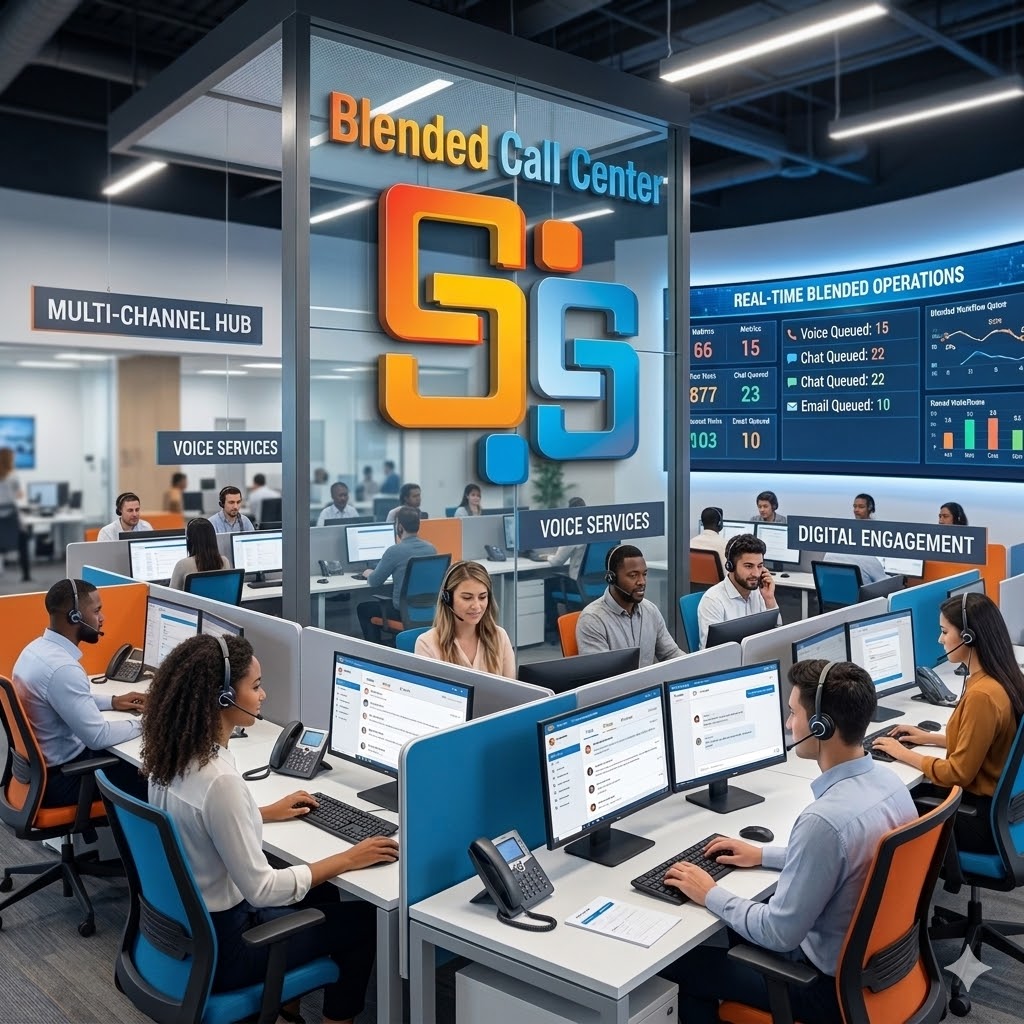
Somewhere between a frustrated customer hanging up and an agent juggling three disconnected tools, you can usually spot the cracks in a contact center. It’s rarely about effort—teams are working hard. The issue is how everything is set up.
I’ve seen this play out with growing support teams. They start with inbound calls, add email support, then throw in outbound campaigns when sales pushes for more reach. Before long, agents are switching tabs, customers are repeating themselves, and managers are stuck firefighting instead of improving things.
That’s where blended call center solutions start to make real sense—not as a buzzword, but as a practical fix to a very real operational mess.
When inbound and outbound finally start working together
Most teams treat inbound and outbound as separate worlds. Different tools, different workflows, sometimes even different teams. It sounds manageable on paper, but in practice, it slows everything down.
A blended setup changes that. Agents can handle incoming queries and make outbound calls from the same system, without jumping between platforms. It sounds simple, but the impact is noticeable almost immediately.
I worked with a mid-sized e-commerce company that had this exact problem. Their support team handled incoming calls about orders, while a separate team chased abandoned carts and feedback calls. Both teams had access to different data, which meant missed context and awkward conversations.
Once they shifted to a blended environment, things started to click. An agent handling a customer complaint could also follow up later for feedback. Outbound calls felt more personal because they were based on actual interactions, not cold lists.
Customers noticed the difference. So did the agents.
Customer experience improves when conversations feel connected
No one enjoys repeating the same issue across multiple channels. Yet it happens all the time—call, email, chat, repeat.
Blended systems work best when paired with an omnichannel contact center approach. That’s where interactions across voice, chat, email, and even messaging apps come together in one place.
Think of it this way: a customer raises a query on chat, follows up with a call, and later responds to an email. In a disconnected setup, that’s three separate conversations. In a blended + omnichannel setup, it’s one continuous thread.
I’ve seen support teams reduce average handling time just by having this context available upfront. Agents don’t waste time asking basic questions. Customers don’t feel like strangers every time they reach out.
And there’s a subtle shift in tone too. Conversations become less transactional and more human.
Agents perform better when tools stop getting in their way
If you ask agents what slows them down, you’ll hear the same things: too many tabs, unclear workflows, repetitive tasks.
Blended call center solutions quietly fix a lot of this.
Instead of assigning agents to just inbound or outbound, you give them flexibility. During peak hours, more agents can focus on incoming queries. When things are quieter, they can switch to follow-ups or sales calls.
This balance keeps agents engaged. It also reduces burnout, which is something many teams don’t talk about enough.
One support manager told me their biggest win wasn’t faster response times—it was happier agents. When people feel in control of their work instead of being boxed into rigid roles, their performance naturally improves.
A quick look at a real scenario
A SaaS company I consulted had a growing customer base but a struggling support system. Their inbound team was overwhelmed with queries, while their outbound team often sat idle between campaigns.
They didn’t need more hires—they needed better coordination.
After moving to a blended setup:
- Idle time dropped because agents could switch roles based on demand
- First response time improved since more agents were available during peak hours
- Follow-ups became more consistent, especially for high-value customers
The biggest shift? Customers stopped complaining about delayed responses. That alone changed how the brand was perceived.
It’s not just about efficiency—it’s about timing
Timing matters more than most teams realize.
A delayed response can turn a small issue into a churn risk. A well-timed outbound call can turn a neutral customer into a loyal one.
Blended systems give teams better control over timing. You’re not waiting for one team to finish before another steps in. The same agent—or at least the same system—handles the journey.
That continuity is hard to replicate with siloed tools.
What to focus on if you’re considering this shift
If you’re thinking about moving toward a blended model, don’t start with features. Start with your current gaps.
Look at:
- Where customers drop off or complain the most
- How often agents switch tools during a single interaction
- Idle vs busy time across teams
From there, build a setup that actually reflects how your team works day-to-day.
Also, don’t rush the transition. I’ve seen teams try to change everything at once, which usually leads to confusion. Start small—maybe combine inbound and outbound for one team—and expand gradually.
A small shift that changes how teams operate
Blended call center solutions don’t feel dramatic when you first implement them. There’s no big “launch moment.” But over a few weeks, the difference becomes obvious.
Conversations feel smoother. Agents seem less stressed. Customers don’t have to chase support as much.
It’s one of those changes that quietly fixes multiple problems at once.
And once you’ve experienced that kind of flow, going back to disconnected systems just feels… unnecessarily complicated.