A production line stops because a fork lift isn’t available. Parts sit in a staging area while workers search for them. Orders get delayed, and overtime costs climb.
This happens every day in plants that rely on manual material handling.
The problem isn’t the workers. It’s the system. Manual movement of materials creates delays, inefficiency, and heavy labor dependency. When one process finishes, the next one waits. Workflow breaks down.
But there’s a better way. Material handling automation solutions eliminate these delays by moving parts, products, and supplies automatically. They connect processes, reduce labor dependence, and keep production flowing.
This guide explains how automation improves workflow efficiency, when to invest, and what systems actually deliver results.
What Are Material Handling Automation Solutions?
In simple terms, these are systems that move, store, and track materials without manual intervention. Instead of workers pushing carts or driving fork lifts, machines handle the movement.
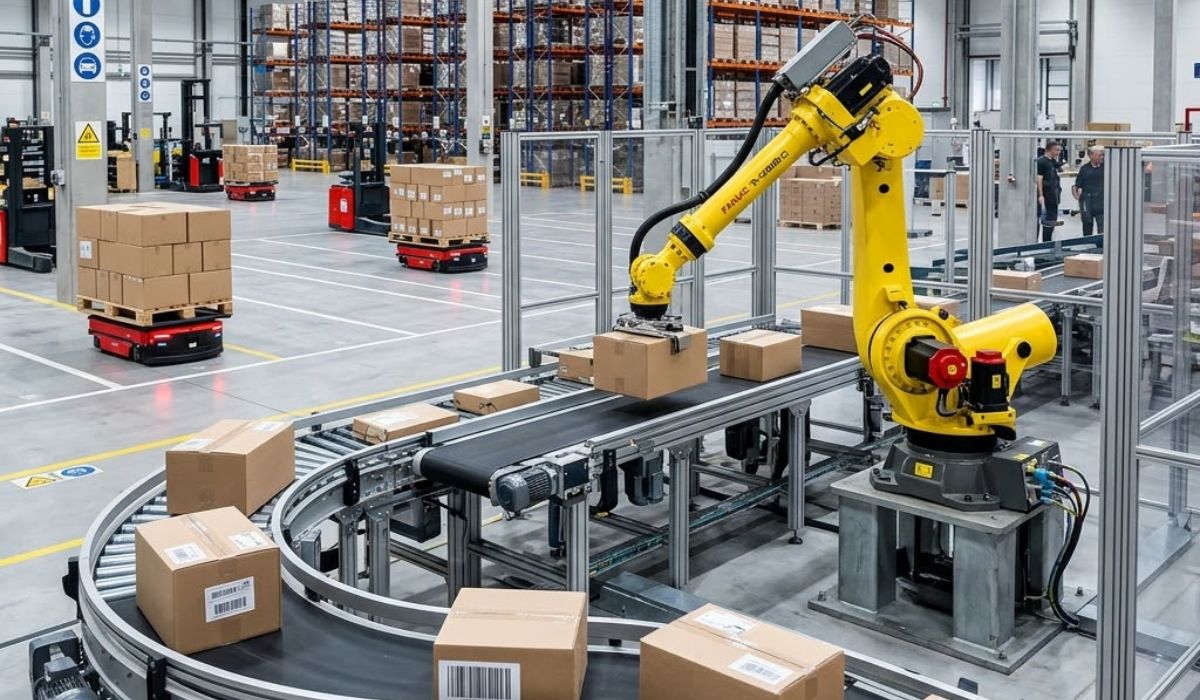
Material handling automation solutions include:
- Conveyors – Move items between workstations automatically.
- Robotic handling – Robots pick, place, and transfer parts.
- AGVs (Automated Guided Vehicles) – Self-driving vehicles transport loads across the facility.
- Automated storage systems – Vertical lifts and carousels bring parts to the operator.
No complex programming knowledge required. These systems integrate into existing workflows. The goal is straightforward: move materials faster, with fewer errors, and less human effort.
For factory owners and plant managers, this means predictable throughput and lower operating costs.
Why Manual Material Handling Fails in Modern Manufacturing
Manual handling worked when production was slow and volumes were low. But today’s manufacturing demands speed and precision. Manual methods create four major problems.
Delays between processes
A machine finishes a batch. Someone needs to move that batch to the next station. If no one is available, the machine waits. Or the next machine starves. Every minute of waiting eats into output.
Human errors
Workers misplace parts. They take items to the wrong station. They miscount quantities. These errors trigger rework, scrap, and missed shipments. In manual systems, error rates increase with fatigue and shift changes.
High labor cost
Moving materials doesn’t add value. Yet manufacturers spend significant labor hours on pushing carts, driving fork lifts, and searching for inventory. As wages rise, this becomes unsustainable.
Safety risks
Fork lifts and manual lifting cause injuries. Back strains, crushed feet, and collisions are common. Each incident means downtime, insurance claims, and lost productivity.
Modern manufacturing cannot afford these failures. That’s why material handling systems are shifting to automation.
Key Benefits of Material Handling Automation Solutions
Faster workflow
Automated movement never takes a break. Conveyors run continuously. AGVs operate through shift changes. Robots handle repetitive transfers at consistent speed. Work moves from process to process without waiting.
Improved accuracy
Sensors, scanners, and software track every item. Systems verify locations and quantities automatically. No misplaced parts. No wrong destinations. Accuracy improves from 95% (manual) to 99.9% (automated).
Reduced operational cost
Lower labor dependency means fewer people assigned to moving materials. Less waste from errors. Less overtime. Most installations pay for themselves within 12 to 24 months through direct savings.
Enhanced safety
Automated vehicles follow programmed paths. They stop for obstacles. They don’t get tired or distracted. Robotic handling eliminates heavy lifting. Injury rates drop significantly.
Better space utilization
Automated storage systems use vertical space. AGVs navigate narrow aisles. Conveyors run overhead. The same floor space holds more inventory and supports higher throughput.
These benefits translate directly to industrial automation goals: higher output, lower cost per unit, and reliable delivery.
Types of Material Handling Automation Systems
Conveyor systems
Belt, roller, and chain conveyors move items between fixed points. Ideal for assembly lines, packaging, and sortation. Simple to install and highly reliable.
Robotic handling systems
Articulated robots, gantries, and collaborative robots (cobots) pick and place parts. They load machines, transfer trays, and palletize finished goods. Flexible and reprogrammable.
AGVs (Automated Guided Vehicles)
These follow magnetic tape, QR codes, or laser navigation. They tow carts, lift racks, or carry pallets. Perfect for facilities with changing layouts or long travel distances.
Automated storage systems
Vertical lift modules (VLMs) and horizontal carousels bring stored items to a pick window. No walking or searching. Operators stay in one zone while the system retrieves parts.
Each system solves specific problems. Many facilities combine two or three types for end-to-end automated material movement.
How Material Handling Automation Improves Production Flow
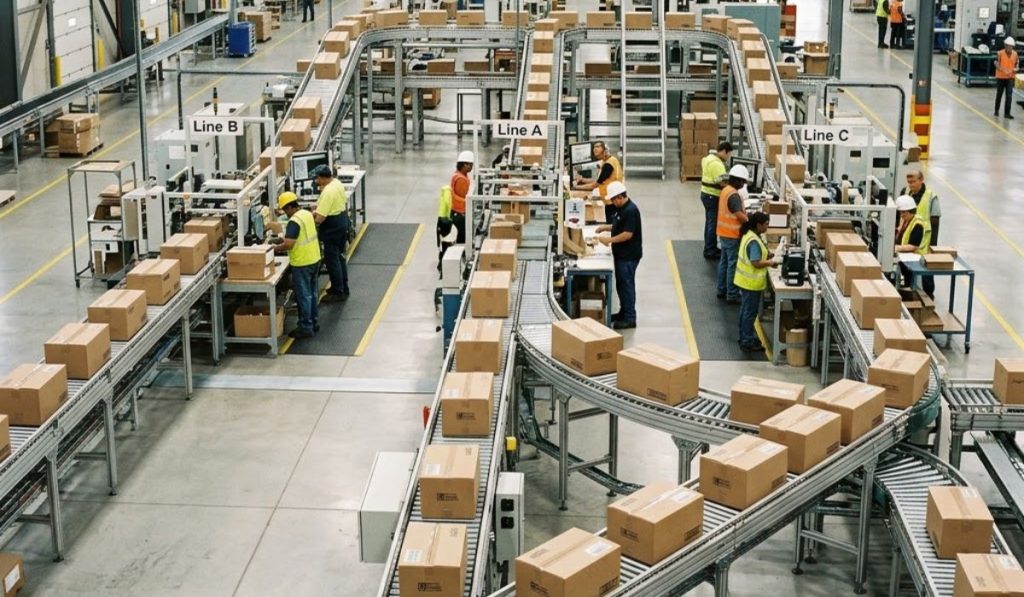
Automation connects processes that used to be separate. A conveyor links a molding machine to an assembly station. An AGV moves finished assemblies to shipping. A robotic arm transfers parts from storage to production.
The result: reduced downtime. Machines run because materials arrive exactly when needed. No starvation. No blocking. No manual coordination.
Bottlenecks disappear. If one machine runs slower, buffers automatically adjust. Automated systems balance flow across the line without operator decisions.
Efficiency improves across every metric: throughput, lead time, and equipment utilization.
This type of automation is widely used in modern manufacturing environments, from automotive assembly to electronics production to food processing.
Manufacturing workflow becomes predictable. And predictable workflow means accurate delivery dates and lower inventory costs.
Why Businesses Choose Parc Robotics
Parc Robotics provides material handling automation solutions tailored to existing facilities. No need to redesign your entire plant.
The focus is on custom solutions that match your specific workflow, process by process. Integration with current equipment and software is standard. Reliability comes from proven components and thorough testing.
Businesses choose Parc Robotics because the systems work from day one, and the team stays involved until production targets are met.
When Should You Invest in Material Handling Automation?

Not every plant needs automation today. But certain conditions signal it’s time.
Production delays – If machines regularly wait for materials, or work-in-progress piles up between processes, automation solves the connection problem.
Rising labor cost – When overtime increases or hiring becomes difficult, moving materials by hand becomes expensive. Automation reduces that dependency.
Inefficient workflow – If workers spend more time walking and searching than producing, automated storage and movement reclaim that time.
Scaling issues – Adding production volume with manual handling means adding people. Automation scales without proportional labor increases.
Ask yourself: How many hours per week do your team members spend moving materials instead of adding value? If the answer is more than 20%, automation will deliver a strong return.
Final Thoughts
Manual material handling creates delays, errors, and high costs. Modern manufacturing demands better.
Material handling automation solutions connect processes, eliminate bottlenecks, and improve safety. Whether you need conveyors, robotic handling, AGVs, or automated storage, the right system transforms workflow efficiency.
Start small. Automate one bottleneck. Measure the results. Then expand.
Manufacturing that moves materials automatically runs faster, costs less, and delivers reliably. That’s the future. And it’s available today.
FAQs
What are material handling automation solutions?
They are systems that move, store, and track materials automatically. Examples include conveyors, robotic pickers, automated guided vehicles (AGVs), and vertical storage lifts.
What industries use these systems?
Automotive, aerospace, electronics, food and beverage, pharmaceutical, e-commerce fulfillment, and general manufacturing. Any industry that moves parts or products between processes benefits.
Is automation cost-effective for small to mid-size plants?
Yes. Many systems scale to fit smaller operations. ROI often comes within 12 to 24 months through labor savings, reduced errors, and higher throughput. Start with a single bottleneck.
Can material handling automation be customized?
Absolutely. Systems are designed around your floor layout, product sizes, weights, and production volumes. Off-the-shelf components are configured to your specific workflow.