Uncategorized
migraine causes nausea, migraine health tips, migraine light sensitivity, migraine symptoms explained, migraine triggers and effects, nausea during migraine, neurological migraine symptoms, photophobia migraine, sensitivity to light headache, why migraines cause nausea
Author
0 Comments
Why Do Migraines Cause Nausea and Sensitivity to Light?
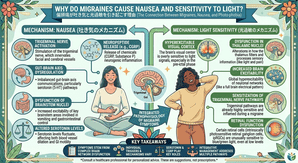
I get asked this question all the time. A patient sits in my clinic. They have just described a classic migraine. Throbbing headache on one side. Nausea. Vomiting. Needing to lie down in a dark, quiet room. Then they look at me and say, “But why? Why does a headache make me sick to my stomach? Why can’t I stand the light?”
Fair questions. The answer is not that the pain is so bad it makes you nauseous. That is what most people think. The truth is more interesting. Nausea and light sensitivity are not side effects of the pain. They are part of the migraine itself. They come from the same brain processes that cause the headache.
Let me explain the biology.
The vomiting center in your brain gets activated
Most people think nausea comes from the stomach. It does not. Nausea comes from the brain. Specifically, an area called the area postrema. It is located at the bottom of your brainstem, near the fourth ventricle.
The area postrema is sometimes called the “vomiting center.” Its job is to detect toxins in your blood and trigger vomiting to expel them.
During a migraine, something strange happens. The trigeminal nerve system becomes overactive. This is the same nerve system that causes the throbbing pain. But it also connects to the area postrema. When the trigeminal nerve fires repeatedly, it activates the vomiting center. Your brain thinks it has detected a toxin. It makes you nauseous. It makes you vomit.
This is why migraine nausea is so intense. It is not psychological. It is not anxiety. It is a direct neurological pathway being triggered.
The gut-brain connection works in reverse
During a migraine, your digestive system slows down dramatically. A condition called gastroparesis. Stomach paralysis. Food and liquid sit in your stomach longer than normal.
This is why migraine patients often feel bloated. Why they feel full after eating very little. Why they cannot keep down food or even water. The stomach is not moving.
Gastroparesis also explains why migraine medications taken by mouth often do not work. The pill sits in your stomach. It does not get absorbed. Your body is not moving it to the small intestine where absorption happens. This is why many migraine patients need medications that dissolve under the tongue, nasal sprays, or injections.
The light sensitivity comes from a different pathway
Photophobia, or light sensitivity, is one of the most common migraine symptoms. Up to 80 percent of migraine patients experience it during an attack.
The old theory was that bright light simply made the headache worse because it was irritating. But that is not correct.
Research has shown that even blind people with migraine experience photophobia. People who have no light perception at all. Their eyes do not send signals to the brain. But they still feel discomfort when light is shone in their eyes.
How is that possible? Because the light-sensitive cells in the eye are not only for vision. There is a special type of cell called intrinsically photosensitive retinal ganglion cells. They do not help you see. They detect brightness and send signals to your brain’s sleep-wake center and pain centers.
During a migraine, these cells become hypersensitive. Normal light levels feel blinding. The signal travels from your eye to your thalamus, the brain’s relay station. The thalamus then amplifies the pain signal. Light literally makes the headache worse.
This is why migraine patients instinctively seek darkness. It is not dramatic. It is biology.
The sound sensitivity follows the same logic
Hyperacusis, or sound sensitivity, works similarly. The auditory pathways in the brain become hyperexcitable during a migraine. Normal sounds feel deafening. A child laughing. A door closing. A phone ringing. These sounds do not just annoy you. They trigger pain.
The same thalamus that amplifies light signals also amplifies sound signals. Your brain is stuck in a state of hyperarousal. It cannot filter out background noise. Everything feels urgent and threatening.
These symptoms are diagnostic clues
Here is something most patients do not know. The presence of nausea and light sensitivity helps doctors distinguish migraine from other headache disorders.
Tension headaches cause pressure or tightness. They rarely cause nausea. Rarely cause vomiting. Rarely cause light sensitivity.
Cluster headaches cause severe pain around one eye. They cause tearing and nasal congestion. But not typically nausea or light sensitivity.
Sinus headaches cause facial pressure and congestion. Not nausea.
So when a patient tells me, “I have headache, nausea, and I have to lie in a dark room,” I am already thinking of migraine before I ask any other questions.
Why treating early matters
Understanding the biology explains why early treatment is critical. If you wait until the nausea is severe and your stomach has stopped moving, oral medication will not work. You have already lost that window.
This is why I tell my patients to take their rescue medication at the very first sign of a migraine. Not when the headache is pounding. Not when the nausea is unbearable. The first sign. The visual aura. The strange mood change. The weird yawning.
Early treatment works. Late treatment often fails.
When to seek help
If you have recurrent headaches with nausea and light sensitivity, you do not need to suffer. Migraine is treatable. Preventive medications can reduce how often attacks happen. Rescue medications can stop them when they start.
Some patients need more than medication. Lifestyle changes. Sleep hygiene. Trigger management. Stress reduction.
In Ranchi, if you are struggling with these symptoms, you can consult a Neuro Expert doctor in Ranchi who understands the biology of migraine. Not someone who just prescribes painkillers and sends you away. Someone who explains why your brain is doing this.
And if you want the best Neuro treatment in Ranchi, look for a doctor who offers a full approach. Acute care. Preventive care. Lifestyle advice. Not just a prescription pad.
The bottom line
Nausea and light sensitivity are not punishments for having a migraine. They are not signs of weakness. They are not psychological.
They are direct consequences of your brain’s biology. The vomiting center gets activated. The stomach stops moving. The light-detecting cells become hypersensitive. The thalamus amplifies everything.
Understanding this helps you stop blaming yourself. You are not dramatic. You are not overreacting. Your brain is literally wired to react this way.
The good news is that migraine is treatable. The right medication at the right time can stop an attack. The right preventive medication can reduce how often attacks happen.
Do not suffer in silence. See a doctor who understands neuroscience. Explain your symptoms. Get a plan. Your brain is doing its best. It just needs some help.











Post Comment