Uncategorized
benefits of studying in New Zealand, higher education New Zealand, international students New Zealand, New Zealand education system, New Zealand student visa, New Zealand universities, overseas education consultants, study abroad New Zealand, study abroad options, study in New Zealand
Author
0 Comments
Why Should You Choose to Study in New Zealand?
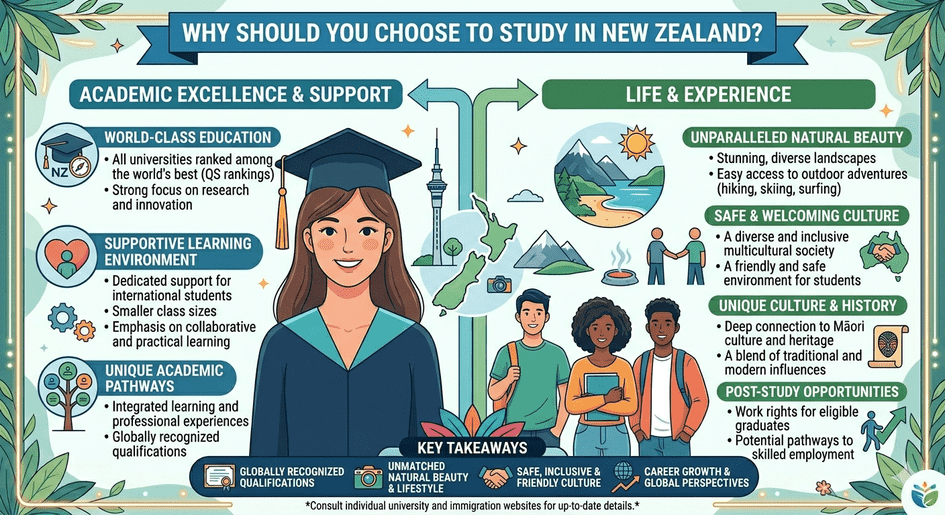
I get asked this question all the time. A student walks in. They have shortlisted the usual suspects. Canada. Australia. UK. Then they pause and say, “What about New Zealand? I’ve heard good things, but I don’t know much.”
Fair question. Until a few years ago, New Zealand was the quiet cousin of English-speaking study destinations. But things have changed. Dramatically. New policies, better work rights, and a historic trade deal with India have pushed New Zealand firmly onto the map.
Let me walk you through why this country deserves more than a passing glance.
The India-NZ Free Trade Agreement changes everything
This is the biggest news for Indian students in 2026. India and New Zealand have signed a landmark Free Trade Agreement . Most trade deals focus on goods and tariffs. This one focuses on people.
For students, the benefits are transformative. Numerical caps on Indian students have been removed. There is no longer a limit on how many Indian students can access these pathways . The agreement also guarantees the right to work at least 20 hours per week during term time . No more uncertainty.
Most significantly, the FTA extends post-study work rights. STEM graduates at bachelor’s and master’s level can stay for three years. Doctoral graduates can stay for four years . That is longer than almost any other English-speaking destination.
The agreement also creates dedicated visa lanes for Indian nationals. 5,000 Temporary Employment Entry visas reserved annually for Indian skilled professionals. 1,000 Work and Holiday visas each year . This is not just about studying. It is about building a career.
Post-study work rights that actually reward you
This is where New Zealand now leads. Before the FTA, post-study work rights were decent but not exceptional. Now they are exceptional.
If you graduate with a STEM degree, you get three years. Not one. Not two. Three full years to work, gain experience, and transition to residency. If you earn a doctorate, you get four years .
Compare this to the UK where you get two years regardless of degree. Canada where the length depends on your course length but typically maxes out at three years. Australia where recent changes have made the path harder.
New Zealand has intentionally designed its system to be student-friendly. The message is clear. We want you to study here. We want you to work here. We want you to stay.
World-class education at more affordable costs
New Zealand has eight universities. All eight are ranked in the QS World University Rankings and are in the top 2 percent of universities globally . That is the same as Australia. The same as many UK institutions. But at a lower price point.
Tuition fees for international students range from approximately 30,000 to 45,000 NZD per year for most undergraduate and master’s programs . That is roughly 15 to 22 lakh rupees. Significantly lower than the US or comparable to affordable UK options.
Living costs are also reasonable. Immigration New Zealand requires international students to show at least 20,000 NZD per year for living expenses . That is about 10 lakh rupees. Auckland is more expensive. Christchurch and Dunedin are more affordable .
The exchange rate works in your favour. The New Zealand dollar has historically been weaker than the pound or the US dollar. Your rupee goes further.
You can work while you study
Every international student enrolled in a full-time program can work up to 20 hours per week during the academic term and full-time during scheduled holidays . The FTA has now guaranteed this right .
At the current minimum wage of 23.95 NZD per hour (effective April 2026) , part-time work can cover a significant portion of your living costs. Many students work in retail, hospitality, or university administration. STEM students often find internships relevant to their field.
Is it enough to live on without family support? For some, yes. For most, it helps but does not eliminate the need for savings. The point is that New Zealand allows you to work without constant visa anxiety.
The lifestyle is genuinely better
I know this sounds like marketing. But ask anyone who has lived in New Zealand. The quality of life is exceptional.
New Zealand consistently ranks among the safest countries in the world. Low crime. Political stability. Friendly people. The Global Peace Index regularly places it near the top .
The outdoors are spectacular. Mountains. Beaches. Forests. You can study in a world-class library in the morning and go hiking in the afternoon. This is not a distraction. This is a stress reliever that improves your mental health and academic performance.
The cities are clean. The air is clean. The public transport is decent. For Indian students coming from crowded, polluted cities, the difference is immediate and profound.
The shift from traditional destinations is real
This is not just my observation. Data confirms it. Between January and August 2025, international student enrolments in New Zealand grew to over 85,000, already exceeding 2024 full-year totals and marking 14 percent year-on-year growth .
Indian students now account for around 14 percent of all international university students in New Zealand, making India the second-largest source market after China .
Why the shift? Because traditional destinations have made it harder. The UK has restricted dependants. Canada has capped study permits. Australia has tightened work rights. New Zealand has done the opposite. They have opened doors .
The education system is flexible
New Zealand’s education system follows the British model but with more flexibility. A typical bachelor’s degree takes three years. Some professional degrees like engineering or law take four. A master’s degree takes one to two years depending on whether it is taught or research-based .
The academic year has two main intakes. February is the primary intake. July is the secondary intake . Apply by October-November for February start. Apply by April-May for July start.
English requirements are standard. IELTS 6.0 with no band below 5.5 for undergraduate programs. IELTS 6.5 with no band below 6.0 for postgraduate programs . Some professional courses require higher scores.
The honest truth about costs and challenges
I need to be honest with you. New Zealand is not cheap. It is more affordable than the US or Australia, but it is not inexpensive.
Rent is high, especially in Auckland. A room in student accommodation can cost 300 to 400 NZD per week . Groceries are more expensive than in India. A dozen eggs can cost 9 NZD. A 3-litre bottle of milk costs around 8 NZD .
International students also have limited access to scholarships, usually only in the first year, and are not eligible for government support like StudyLink loans .
But here is the counterpoint. The wages are higher. The quality of life is better. And the post-study work rights give you time to earn back your investment. Many students find that the initial financial strain is worth the long-term outcome.
Who should choose New Zealand
You should choose New Zealand if you want a genuine path from student to resident. If you value quality of life over brand names. If you are studying STEM, healthcare, IT, engineering, or agri-tech – fields where New Zealand has skill shortages. If you want a safe, clean environment to focus on your studies. If you are willing to work part-time to support yourself. If you want to stay after graduation.
Who should look elsewhere
You should look elsewhere if you need a massive, bustling city with 24/7 nightlife. Auckland is nice. It is not Mumbai or Delhi. If you cannot handle cooler weather. If you are studying humanities or arts and need a huge network of cultural institutions. If your budget is extremely tight and you cannot afford the upfront costs.
The role of study consultants
If all of this sounds good but overwhelming, that is where study abroad consultants come in. A good consultant helps you shortlist universities, navigate applications, understand visa requirements, and apply for scholarships.
But be careful. Some consultants push specific universities because they get commission. Ask your consultant directly. “Which New Zealand institutions do you have formal agreements with?” If the list is short, dig deeper.
Look for consultants who are certified by Education New Zealand. The ENZRA certification means they have been trained and approved . Also check their visa success rates and talk to past students.
If you are ready to explore this option seriously, start researching study in New Zealand programs through official sources like Education New Zealand. And when you need help with applications, find study abroad consultants who have specific experience with New Zealand, not just general counseling. The right consultant saves you time, money, and visa anxiety. The wrong consultant wastes all three. Choose carefully.











Post Comment